By Leo Schwarz
Electricity demand in the United States is growing again after a long pause. For about fifteen years, national consumption stayed almost flat. Over the last five years it has grown by an average of 2.1 percent a year, and the EIA expects it to keep growing through 2050. Data centers are the biggest single reason, and S&P Global expects them and other large industrial loads to add more than 45 gigawatts of peak demand through 2035. The EIA projects that installed generating capacity will need to rise by 50 to 90 percent by mid-century.
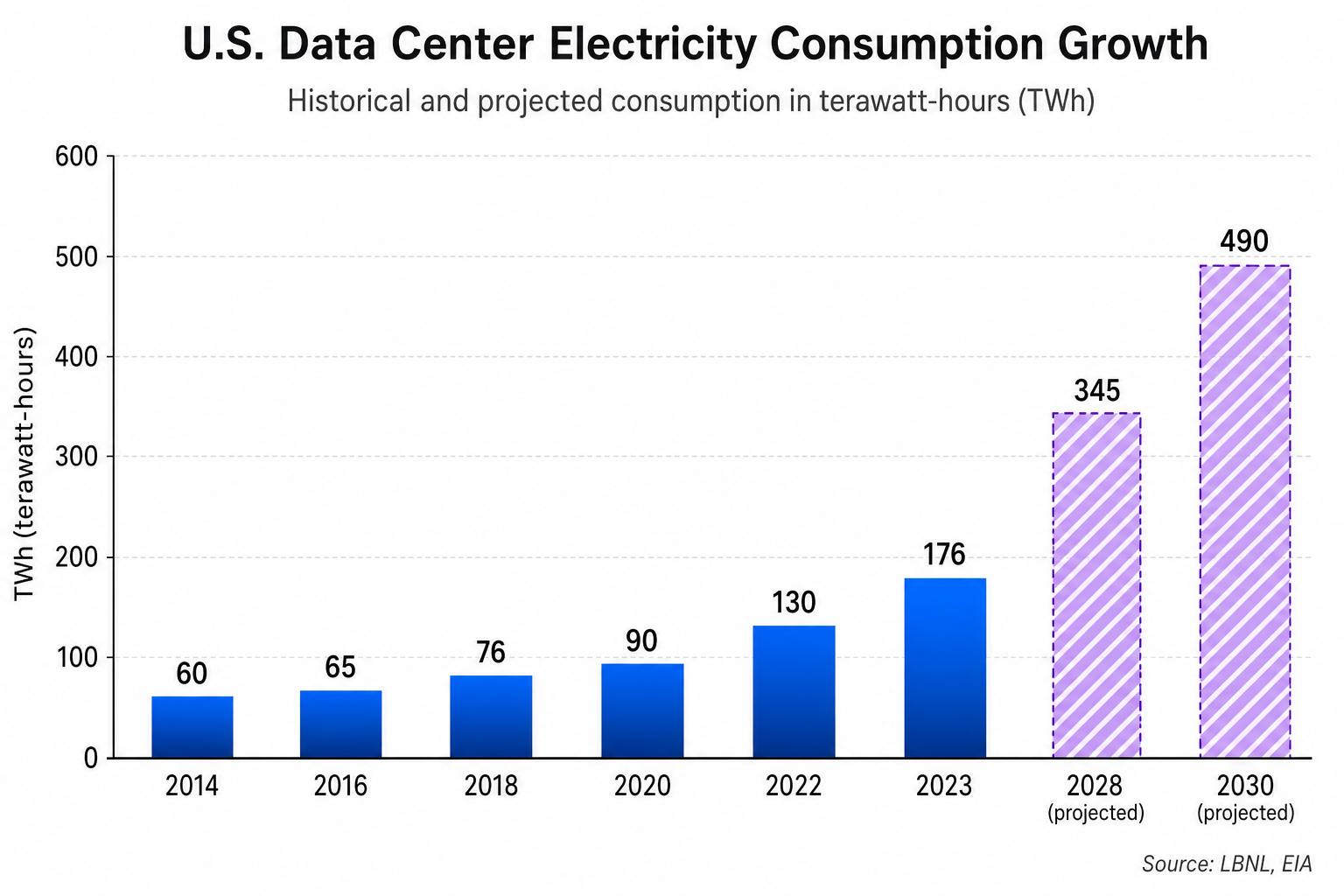
That creates a question every state and every utility now has to answer. When you need more capacity, do you build it, or do you free it up from the homes and buildings you already serve?
In a February 2026 report called Faster and Cheaper, ACEEE found that the largest utility efficiency programs save energy at a median cost of about 21 dollars per megawatt-hour. New combined-cycle gas plants have a levelized cost of 45 to 108 dollars per megawatt-hour.
What matters most is what this argument does not depend on. It needs no climate rationale. A heat pump that lowers a home's peak creates capacity, and it is cheaper capacity than a turbine. Utilities and regulators can reach that conclusion on cost and risk grounds alone.
Being cheapest does not make it automatic, though. When demand rises quickly the reflex is to build, because a new plant is a visible answer to a visible problem. Efficiency has to be argued for every time a plan gets written.
There is a second reason efficiency keeps having to justify itself, and it comes down to how the programs get paid for. In the Northeast, ratepayers fund them through a charge on the monthly utility bill. That works when bills are stable, and bills have not been stable. In Massachusetts, a typical electric bill has gone from roughly 130 to 160 dollars a month a decade ago to a peak around 250, and a typical winter gas bill from about 140 dollars to more than 320.
Here is the part that shapes everything downstream. The efficiency charge appears on the bill as its own line item. Most of the cost of new generation and distribution does not, because it sits inside supply and delivery rates where a customer cannot see it separately. So a legislator looking for something to cut can point at the efficiency charge. Pointing at a utility's rate base is much harder.
Under that pressure, programs are converging on the same answer. Pay more when a project delivers more energy savings, and require the project to be deep enough to deliver them.
New York's Clean Heat program will soon pay more when a home meets a defined weatherization standard, and by 2028 that standard becomes a prerequisite for any incentive at all. New Jersey's Whole Home program sets the rebate from a project's projected total energy savings, calculated during a required home energy assessment, so a deeper retrofit earns more. Massachusetts already asks for weatherization before its whole-home heat pump rebates.
Different instruments, one question underneath: what does this dollar buy?
That is the right instinct, and it changes the job in two ways. Programs verify more before the money goes out, and they ask for more in the project itself. A heat pump swap becomes an assessment, then weatherization, then the install. These changes add work, and that work lands somewhere.
Because of the added documentation, paperwork takes hours, and for a small shop those hours are real money. Because the project now has stages, a single job can involve an assessment, an insulation crew, and the install, each with its own forms and its own timing. Rules change between one quarter and the next. And payment still arrives weeks after the work is finished, which is manageable for a company with a strong balance sheet and difficult for a three-truck operation.
Then there is the quoting problem. A contractor who knows the current numbers can price a job with confidence, and most cannot because the verification process is so burdensome. In our conversations with contractors, one told us he sometimes does not mention rebates to customers at all, because he cannot predict what the customer will actually get. That is what program complexity costs, in one sentence, from someone who does this every day.
When the friction gets high enough, contractors quietly stop participating. And a program with fewer participating contractors performs worse on exactly the cost-effectiveness numbers it is now being judged on.
Which points at the fix. Help a contractor confirm the exact rebate amount before the job starts and stand behind that number, so it can go straight into the quote. Take the filing off their desk. Shorten the wait for payment. Do those three things and the homeowner gets the incentive on the promised timeline, the contractor can afford the next job, and the program converts more of its budget into delivered savings.
That is an unusually aligned problem. The program administrator, the contractor, and the homeowner all want the same fix.
There is a widespread impression that the incentives for this work have gone away. They have not. What went away was the federal tax credit layer, always the smaller part. Utility efficiency programs spent a record 8.8 billion dollars in 2023, against roughly 2 billion claimed under the federal home improvement credit. States and utility regulators still hold most of the money and most of the authority.
Almost nowhere is a state asking whether to run a program at all. New York has committed budgets through 2030. Even in Massachusetts, where the largest cut in the region is on the table, both chambers assume Mass Save continues.
What is changing is the standard, not the commitment. Programs now have to show they are the cost-effective option they claim to be, and that is a question about process rather than politics. It gets answered in overhead ratios, paperwork hours, and days between a finished install and a payment. Which means the least glamorous part of this system turns out to be the part that decides how much of it survives.
Interested in Coral? Get in touch →
© 2026 Guidelight Technologies, Inc