By Leo Schwarz
Governor Sherrill signed the Data Center Fair Share Act on July 7. Most of it does what other states have done: large data centers get their own rate class and pay for the wires, substations, and generation built to serve them, so the cost stops landing on everyone else's bill.
One provision goes further.
Build it, bring it, or buy it. Data centers are increasingly expected to secure their own power one of those three ways, and states are writing that expectation into their rules. New Jersey went further and added a fourth. A data center can pay to free up power that existing buildings waste, and get credit for the capacity that frees up.
Each utility has to set up a program where a data center funds verified demand reduction at other customers on its system. No other ratepayer can be charged for it. Data centers that commit move up the interconnection line, which matters when the queue is the thing standing between a hyperscaler and a working facility.
The law also settles an argument that has run for years. It defines a capacity resource as generation, storage, demand response, demand reduction, or energy efficiency. Efficiency now sits in New Jersey statute as a way to meet demand, ranked alongside building a power plant.
The Board of Public Utilities spends the next twelve months deciding which upgrades qualify. Canary Media reports the intent is home energy upgrades. Commercial and industrial sites can qualify too, and while both will compete for the same dollars, both create the capacity the state is after.
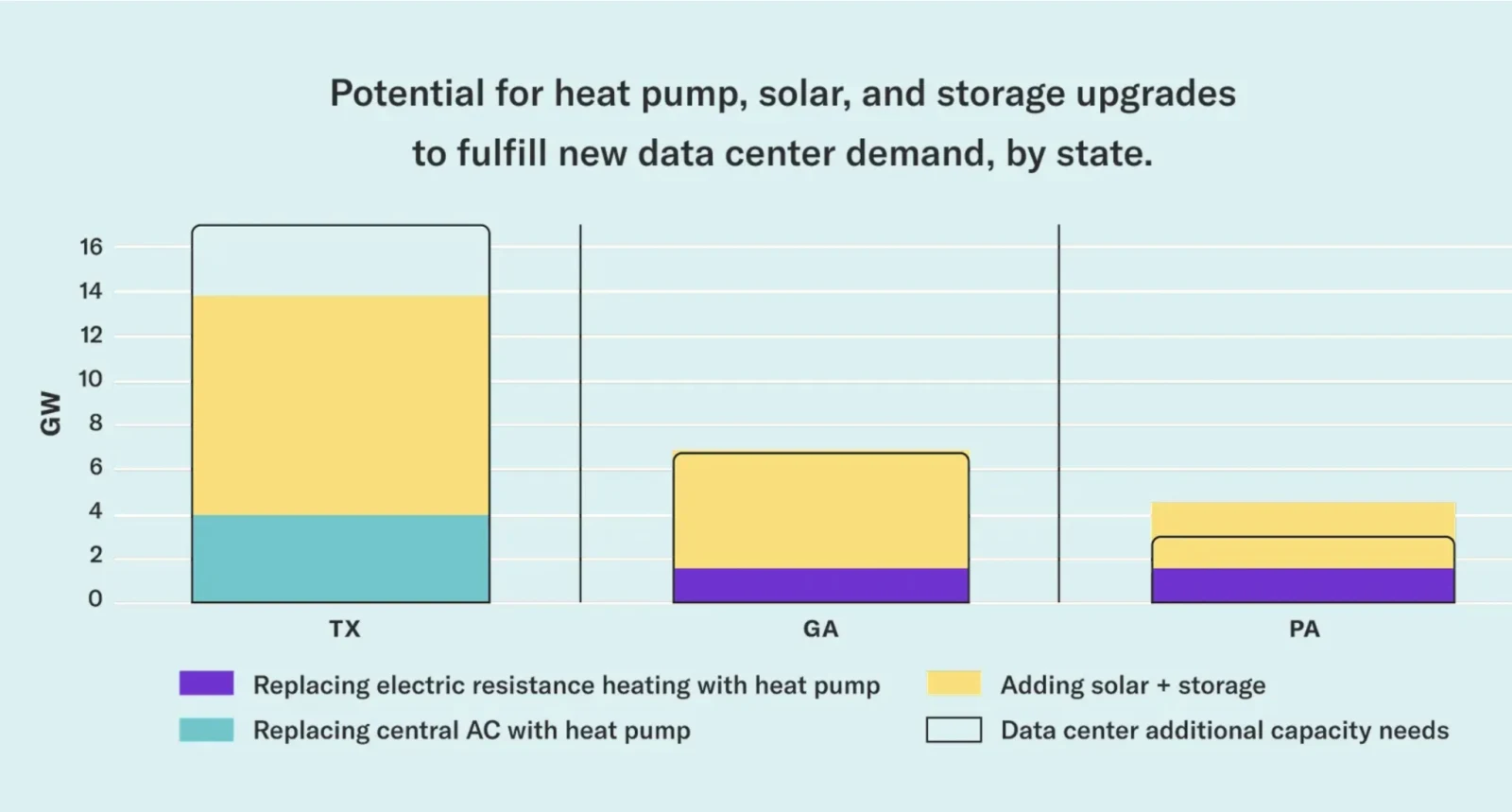
Heat pumps have a strong claim, and the reason depends on when a state peaks. In winter-peaking states, replacing electric resistance heating with a heat pump cuts the winter peak sharply. In summer-peaking states, including those served by PJM, the grid operator for New Jersey and 12 other states, replacing an inefficient central air conditioner similarly cuts the summer peak. Electric resistance water heaters convert well almost anywhere. Add controls and a battery and the same house can shift what it uses in time, running the water heater overnight and coasting through the evening on stored power.
Rewiring America's estimate is that covering part of the upfront cost buys a hyperscaler capacity at a price comparable to a new gas plant, and it arrives years sooner.
Across our New York residential rebate projects, 5.8 percent replaced electric resistance heating. That number tells you where the volume in the Northeast actually sits, and it points at the air conditioning and water heating conversions as the larger openings here.
Assume the Board writes rules that include this kind of work. A hyperscaler needing capacity in a New Jersey service territory by a fixed date would be buying installed equipment, at volume, on a deadline. That money reaches buildings through the contractors, distributors, and manufacturers already selling this equipment.
Volume of that kind also does something durable. It builds installer capacity, grows familiarity with the work, and pulls costs down for every customer who comes after.
Households could start receiving data center funded upgrades around 2028. Until then, the eligibility list stays open, and what qualifies will be decided in dense filings.
Which means another program, another rulebook, and another set of records to keep, on top of everything a contractor already carries. Our team tracks these programs as they change so contractors do not have to, and we will be watching this one closely as the Board writes the rules.
Interested in Coral? Get in touch →
© 2026 Guidelight Technologies, Inc